
I don’t fix problems. I fix my thinking. Then problems fix themselves.
-- Louise L. Hay
Only 1% of the choices are meaningful in life, such as job, settlement, partners and so on. They shape the foundation of our lives. For the rest 99% of the choices, they don’t really matter much. Three main factors in finding a job: industry, company, and position. Personal growth and compensation depend on industry and company, while position brings career path and leadership in the company.
Here, I give the underlying logic and top-level theory to complete such decision model:
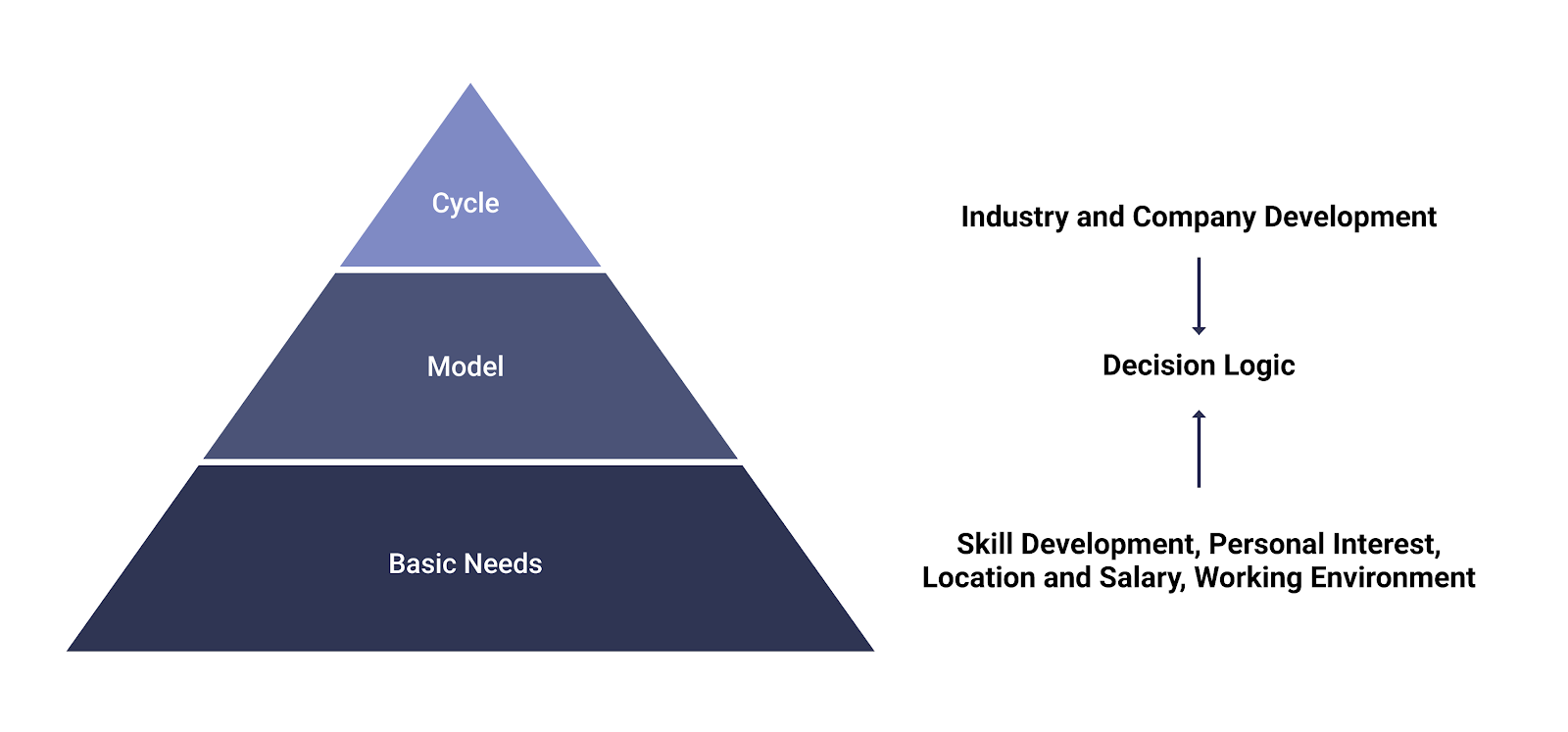
The core idea of this model is to make decisions based on one individual’s basic needs in the career and the understanding of how well the industry and company can grow. There are three reasons I bring up this model:
- As we age, the decision cost becomes more expensive. Every job change is critical. Every single change would gravely affect our lives. A bad outcome brings harm not only to 8 hours a day. It could destroy people’s life. On the other hand, a good outcome would turn into a wonderful life experience. We would be able to learn more skills and work with excellent people.
- After working for several years and being more experienced, more opportunities would appear from the job market. This model would help to find out the best opportunity.
- This model can also help to think of career along with life planning. Many people are clear about what they want now. It is very easy to make mistake so that one would take the high compensation job while underestimating the risk in the long run.
Basic Needs
An ideal job has the intersection of three factors: interests, capability, and benefits.
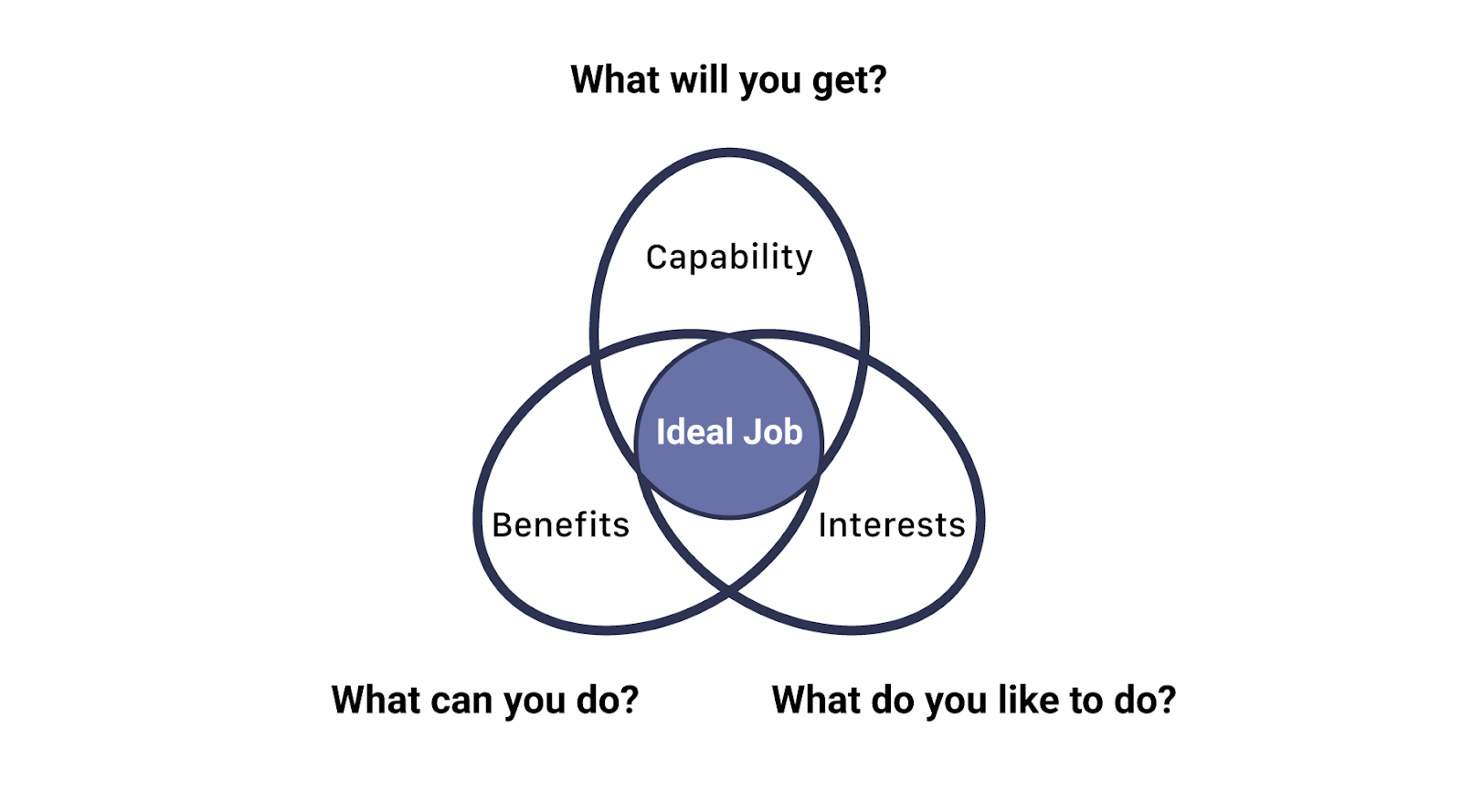
What Do You Like to Do?
This is the most basic, but it is also the most important question you need to ask yourself. No one cares about how you like your job. People would likely to ask the position, the company growth or the compensation, but they are unlikely to ask what you like the most from this job. After a while, you may forget the original interests when you start this job, so you want to keep asking yourself this question from time to time if this is something you still like to do in this job.
Interest may change. Both achievement and feedback from others can affect it. In the other words, you can form new interests during your job, so interests should not be some specific work because this will limit your choice. It is more of understanding the basic needs that make you happy. The best scenario is to find a job you really like. Otherwise, you try to like what you are working on.
What Can You Do?
This is how you seek the best match based on what employer’s expectation and your own capability.
What Will You Get?
The tangible aspect is wages and benefits while the intangible aspect is the skill development, team culture, and work location.
I want to focus more on salary, team, and location here. In most peoples’ perspectives, the expected wage is calculated based on a number of years of work experience and the average wages of the similar position in the job market. In fact, the real calculation should be:
Salary = Individual’s Irreplaceability + Industry (Company) Needs
The individual’s irreplaceability is Alpha, and the industry (company) needs is Beta. The addition of the two is the investment (salary) that the company is willing to give you. More explanation would be given in the latter section when we discuss the top level theory.
If the working experience in years is the X-axis and the salary is the Y-axis, then the relationship between the two will be a concave polynomial curve shown below:
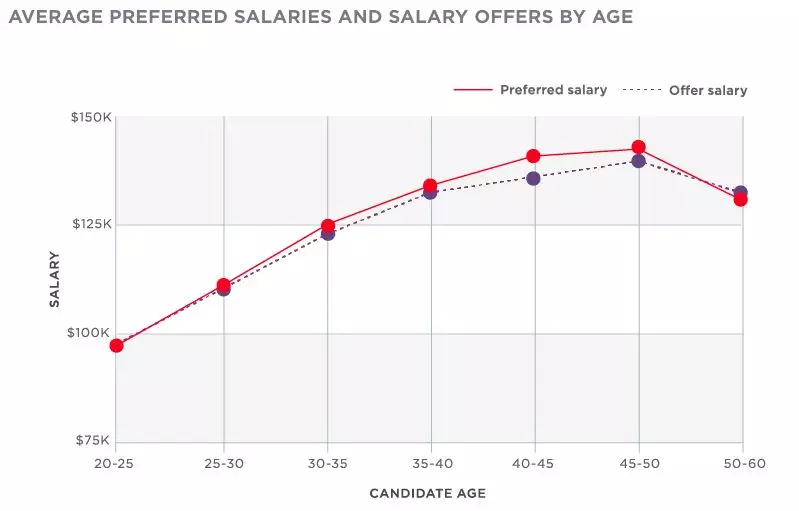
This picture shows that salary apex is between around 45-50. In the information era, the apex will shift even more to the left, i.e. the peak age of normal people will come earlier, and then the individual’s value will depreciate while aging in the job market.
The team culture is often perceived afterward. Thanks to the internet, some of the information is online. Try to find reviews or posts describing company's work intensity, culture, bonuses, fundraising, whether everyone believes in the company's vision, and so on.
The requirement for job location does not have a high priority when people are young, but it becomes more and more important. Regardless of age, location is critical because it gradually influences people. The friends you hang out with or the people you compete with are met based on where you live, and their personal qualities shape your personal qualities. A company should not be the only factor when it comes to a decision, industry, and location would make more impact in the long run.
Understanding three factors of basic needs in the model can help us be clearer on how to make career plans responsively, not only aiming for higher return but also finding out what personal interests are.
Industry Life Cycle
The reason for adding the industry life cycle in this model is because the growth is usually non-linear. We have seen cases like British first industrial revolution, Yahoo, Nokia, etc. Based on their innovation, they all once climbed to the top of the world. Because of the nonlinearity, the uncertainty we are facing is much more unpredictable than previous generations. The following equation will explain the impact to our earnings from non-linearity.
Capital Pricing Formula: Return = Alpha + Beta
- Alpha is your personal excess return compared to all competitors in this industry.
- Beta is your gain from macro changes. You get the benefits passively when you enter an industry.
In another word, Alpha is from how good you are comparing to others, and Beta is because the choice you make maybe better than others. Some examples below:
| Alpha | Beta |
|---|---|
| Buy house 10 years ago | Start your own company and biring it to IPO |
| Buy Bitcoin around 2013 | Work on some side projects |
| Do internet related work in past 20 years | Invest in stocks |
First of all, personal income is the sum of Alpha and Beta, not just personal effort (Alpha). Many people consider the dividend from industry life cycle as a personal achievement so that they would apply the same experience to different industries or to a different period of time in the industry life cycle. They would likely fail in the new industrial changes. Understanding the boundary between Alpha and Beta can help us examining ourselves more objectively, and it also helps us to avoid weaknesses and settle with better judgments.
Secondly, Alpha is not exclusive. It is a coefficient after you compare with other competitors horizontally. Maybe you are very good at what you do at work. However, if the people around you are even better than you, your advantage would not exist. This is why another equation was stated in the section on basic needs:
Salary = Individual’s Irreplaceability + Industry (Company) Needs
In a working environment, the most efficient way to make a large return is to show your distinct strength. Similarly, when you enter a new industry, you will need to pay attention to other competitors in the same industry. How they are doing and how different you are doing make a big difference in the long run.
If a market is 100 times larger, but it has a 10% growth rate and 10,000 competitors, and there is another industry that is 10 times larger and grows 50% faster with only 100 competitors, it becomes very clear to see which track to set your feet on when you apply such model.
Finally, the judgment toward Beta should be subjective. We must get ready to bear the risks when making a decision on whether or not to enter into a new industry. Setting a rational limit on investments, such as time and money equivalents, based on industry life cycle can help cut the loss if the growth is worse than expected. The book “Black Swan” says the optionality is the ability to use controllable resources to bear the acceptable risk. If the choice is correct, the return can be extremely high.
To sum up, the model of three basic factors, (interest, capability and benefits) described in the previous section matches the capability of individual to the expected return and pleasure from a traditional perspective, while the concept of industry life cycle provides a top-down viewpoint that helps us realize that the growth of world and individuals are nonlinear. It helps people to make better choices when facing uncertainties.
Decision Model
Finally, let’s focus on the decision model itself: the industry, company, and position.
Industry: Which industry to entry is the hardest decision to make objectively, but it is the most impactful decision toward the whole model. Unfortunately, no such model to quantify the decision process. One has to research and follow the movements in different industries. Talking with experts in different industries can definitely help in making decisions based on their experiences.
Company: The Internet has broken the geographical restrictions, but it has also formed a serious Matthew effect. Only top three of all the competitors on the same track would survive, sometimes even the third would have a hard time to survive.
Whenever a new outlet appears, the capital would all flow into it, which makes a profitable industry condensed in a short period of time, draining the market profit space. Small and medium-sized players are difficult to raise more money. Also, the existing business model has nothing innovative to compete with large players. A miserable ending is inevitable.
Some people often ask me for career counseling. One of the common questions is, should I go to a big company or a small company? Many of them are newly graduated students. In this case, I generally recommend going to a big company. It is not that I am biased against startups, but rather from the perspective of the inquirer. Generally speaking, the person who asks this shows that he has three conditions:
- He does not have the intention to run a startup. Entrepreneurs should have very determined wills to be persistent on the things they believe in, and those who really want to start a business will not ask for job-related matters.
- He does not think thoroughly. People who really want to know will not ask whether they are big companies or small companies. They have their own decision-making models, those who seek advice directly from others must not have thought deeply about their own needs or lack of practical experience.
- He is vague about long-term planning. If long-term planning is clear, short-term decisions can be made easily.
Based on this, I generally recommend them to big companies. The training and internal processes of big companies are more professional and standardized. In the early stage of their career, it will be more helpful for people's professionalism and professional training. Large companies usually bring endorsement based on their brands, and because of that, it will be easier to go to other companies in the future.
Position: Different companies have different genes. They have different values, business models, and things they are particularly good at. Knowing what is driven in the company is important for planning career development. It would be wise to choose companies and positions that could leverage most of your capabilities.
At the same time, some occupations have a certain demand for the size of the company. For example, data scientists, if you are determined to strengthen your career in this field, you must choose a company with a large amount of data, and the company has data scientist leaders in the industry to help guide your career development. With these two conditions, only unicorns or ad-tech companies are qualified.
Seeking the company from the industry and seeking the position in the company are the ways to choose your next job. Usually, one should select three most desired companies in mind based on the interests and past experience, and then, learn more from experts to further understand your choices, whether one is competent, whether the jobs are in the good industries. With such targeted seeking methodology, getting your next job become very efficient.
Final Words
This article is from my own experience. I think it is always good to share this article with friends and others you care. Especially, when you or someone have the pressure of unemployment or a strong desire to find another job. Finally, as always, I wish the best of luck to all who are now finding jobs!